We said goodbye to our friends and grabbed a bus right in Kawayu Onsen. The Kumano Travel website sold us a ticket that got us from our small town all he way to the mountain town of Koyasan, which was about a 4-hour bus trip. It was impressive because there was not just one bus, but three public buses across two different companies. It cost about $35. The driver of each bus had my name, and they would pull up next to the other bus in a lot, allowing us to transfer. No one spoke English, yet it was seamless and relatively easy to understand. I later learned that I missed a nice view from the Gomasan Sky Tower during our last transfer.
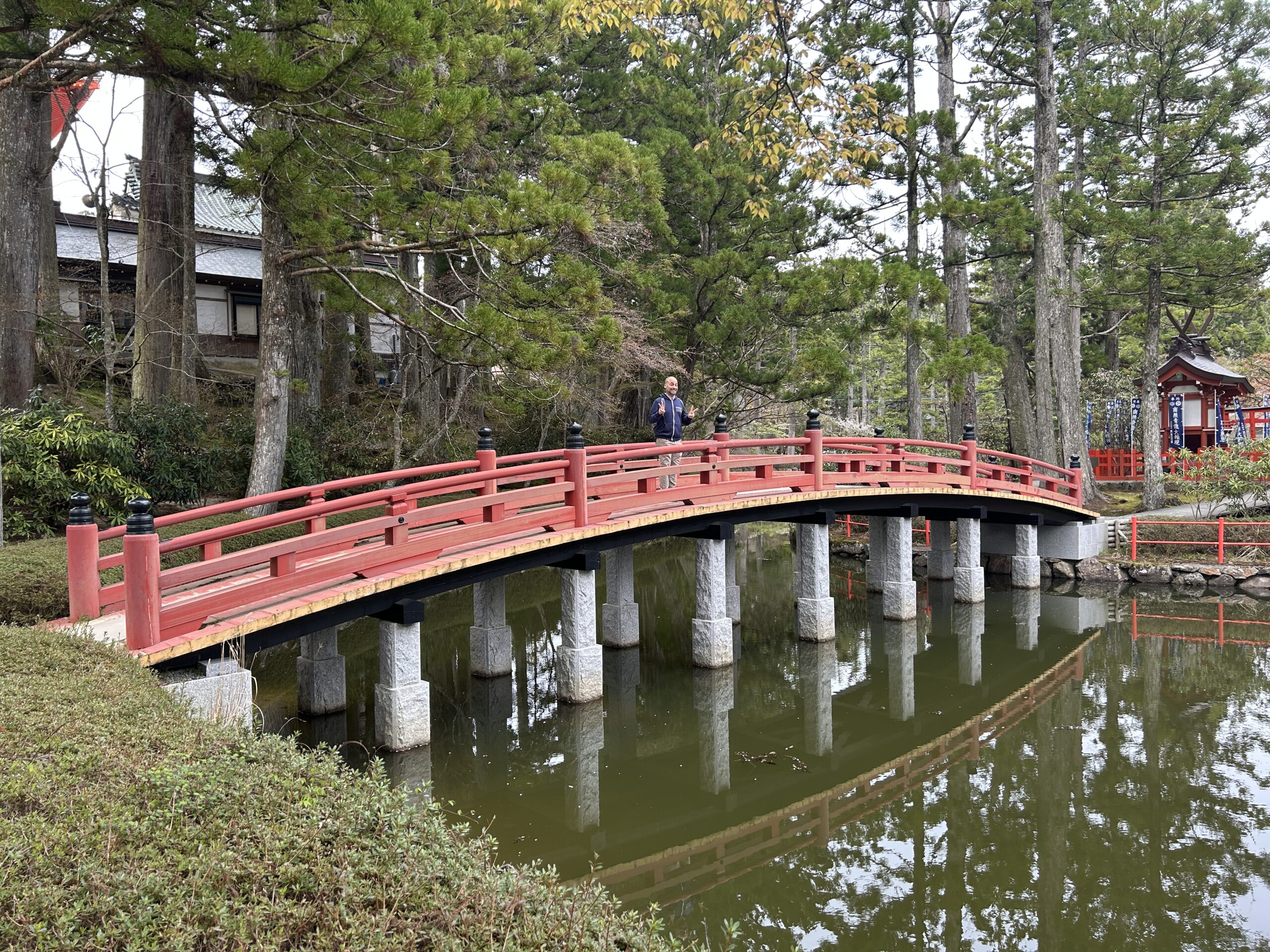
The bus eventually drops you off in the forested town of Koyasan, another UNESCO World Heritage Site. For many, the entire village is a sacred site. It was one of the most peaceful places I’ve ever experienced in the entire world.
Koyasan is the heart of Shingon Buddhism, and it is home to numerous temples. Many of them rent rooms, and we stayed overnight in the Kodai-in Temple guesthouse. We booked it by contacting https://eng-shukubo.net/. The sleeping arrangements were much nicer than the previous night. Dinner and breakfast were included in the stay at the temple. Both meals were shōjin ryōri (vegetarian monk’s meal).

While exploring the town, I had my first bowl of ramen in Japan. It was at Kadohama Goma-tofu, a tofu specialty shop, but I had delicious noodles, and Sam had a sweet tofu dessert. Afterwards, we walked toward the Okunoin cemetery, where I found a shop (Kamikishiya) selling the best mochi of my life. I do not love mochi; I find the texture odd, but I don’t hate it. I typically ignore it, but this was mochi with a whole strawberry inside and deep-fried. It was delicious! It’s like a mochi made for me. Flavors and textures I both enjoy. Homerun.
One of the highlights of my entire trip was walking through Okunoin cemetery. This is Japan’s largest cemetery, where towering cedar trees line the path to the founder of Shingon Buddhism’s mausoleum. His name is Kōbō Daishi. He founded a monastic complex here over 1,200 years ago, and today, more than 100 temples are still in operation. There is a deep sense of serenity and reverence in Okunoin.


It’s a beautiful place that serves as a confluence of humanity and nature. There are tombs and monuments everywhere, but they are shaded by trees and covered in moss. It’s not dark, but the sun isn’t there for you. The space is quite special and somehow captures the idea of how thin the veil between life and death is. Perhaps I was tired and simply being contemplative while I was there, but it did prompt me to think a bit esoterically.
We spent the remainder of the day walking the length of Koyasan to see some of the other temples. I noticed an advertisement to see a Buddhist fire ceremony or “goma”, and we passed on it. I regret not doing that.
Our destination was Kongobu-ji and Danjo Garan. I enjoyed the Danjo Garan complex quite a bit. It was founded in the 9th century and laid out like a mandala to reflect Buddhist cosmology. The Konpon Daitō pagoda is very famous and the golden hall (Kondō) has a very large statue of Buddha in it.. While we were there we stumbled upon the the Rokkaku Kyōzō (六角経蔵), or Hexagonal Sutra Repository. This is (was?) a rotating library was designed to house and protect Buddhist scriptures (sutras). Sam pushed the wheel around it. Supposedly if you give it one full go, you get all of the knowledge of the sutras within it.
Afterwards we did a quick visit to Kongobu-ji, the head temple of the sect and then made it back to our temple to rest before dinner. The Kodai-in Temple guesthouse is at the Koyasan Kodaiin Temple. Here is what their site says about it:
Koyasan Kodaiin Temple, also known as Kouya Omuro (高野御室), was founded around 900 years ago, in 1125, by Imperial Prince Kakuhou, the fourth son of Emperor Shirakawa. This temple is famous for being a place where a member of the imperial family, who later became a monk at Ninnaji Temple (仁和寺) in Kyoto, lived a simple life. Ninnaji Temple has strong connections to Japan’s imperial family. Kodaiin Temple belongs to the imperial branch of Omuro Gosho (御室御所) and is located within Koyasan’s area. Because of its ties to the imperial family, Kodaiin Temple operates independently from Koyasan’s authority and holds the highest status in Mt. Koya. Kodaiin also hosts two national registered monuments designed by Shigemori Mirei(重森三玲), a famous garden designer in Japan in the 1970s. (Site)
These accommodations were very good. It was another bed on a floor, but it was much more comfortable than the previous night. It was a spacious room with very nice amenities that looked out to the garden. They give you some traditional clothing to wear while you are there, so here is my “white people in kimonos” photo. Technically this is a yukata and a haori.

You do not eat with others in the hotel and you get your own private room. Shojin cuisine is a completely vegan and it relies heaving on what is in season. Japan does not shy away from animal product so it was nice to have something a little different. They served goma tofu, a unique tofu made from sesame rather than soy. The shojin cuisine is is not just a diet—it’s a mindful, meditative approach to food, where balance, harmony, and gratitude are central to every meal. This is marketed as simple monk’s food. There was nothing simple about this meal. I loved it. That certainly seems more civilized than me eating a hotdog while I walk down the street in Philadelphia.


The rooms do not have private baths, but once centrally shared shower and bath, so it men and women had different hours to use. That being said, it was very relaxing, and I truly do not mind communal bathing. There was no one there, while I was cleaning up but the onsen was hot and the mountain air was cool, it put me to sleep faster than a melatonin. I was starting to feel traveler fatigue, so I was glad to go to bed very early.
Next: Japan – Day 7: Osaka